

Online Coaching with the help of AI
Adding an AI chat feature to the existing app “Trainerize” to help online trainers boost efficiency & save time making it effortless to scale their business


MY ROLE
UX/UI Designer
TIMELINE
4 weeks
PROJECT TYPE
Case Study
INDUSTRY
Healthcare / Wellness
TOOLS USED

KEY DELIVERABLES
✓ Competitive analysis
✓ User persona, insights, story boards
✓ Feature prioritization matrix, user flows
✓ Med & high-fidelity wireframes (iOS)
✓ User testing insights
✓ Interactive prototypes & usability testing
BACKGROUND
Trainerzie: Online Coaching Platform
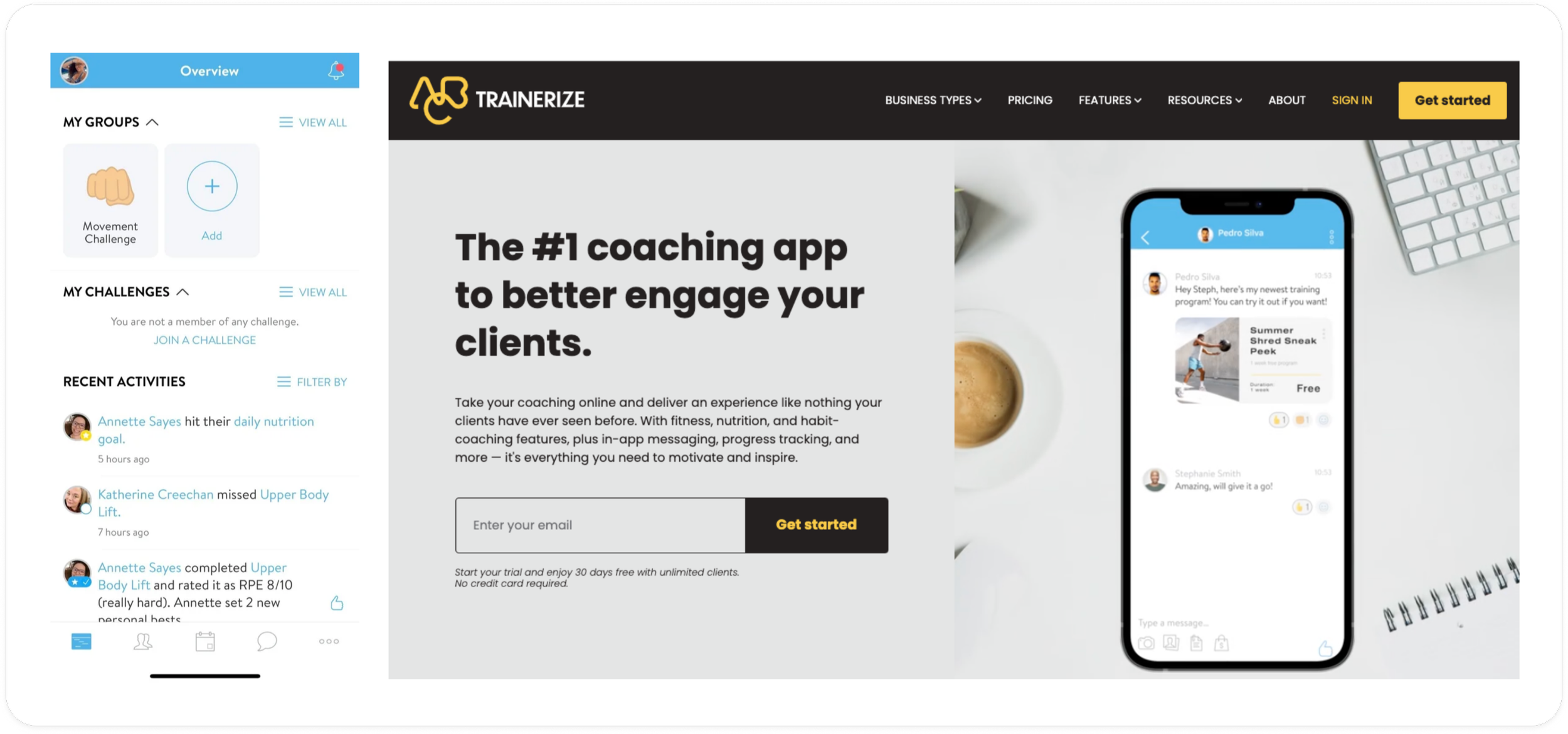
Trainerize is a leading coaching app designed for personal trainers and fitness professionals. It provides tools for workout programming, nutrition tracking, habit coaching, and client communication, all in one platform. Available on iOS and web, Trainerize enables trainers to deliver online coaching anytime, anywhere. Through this case study, I’ve identified opportunities to enhance the app with a new AI feature to further streamline trainer workflows and improve client support
THE CHALLENGE
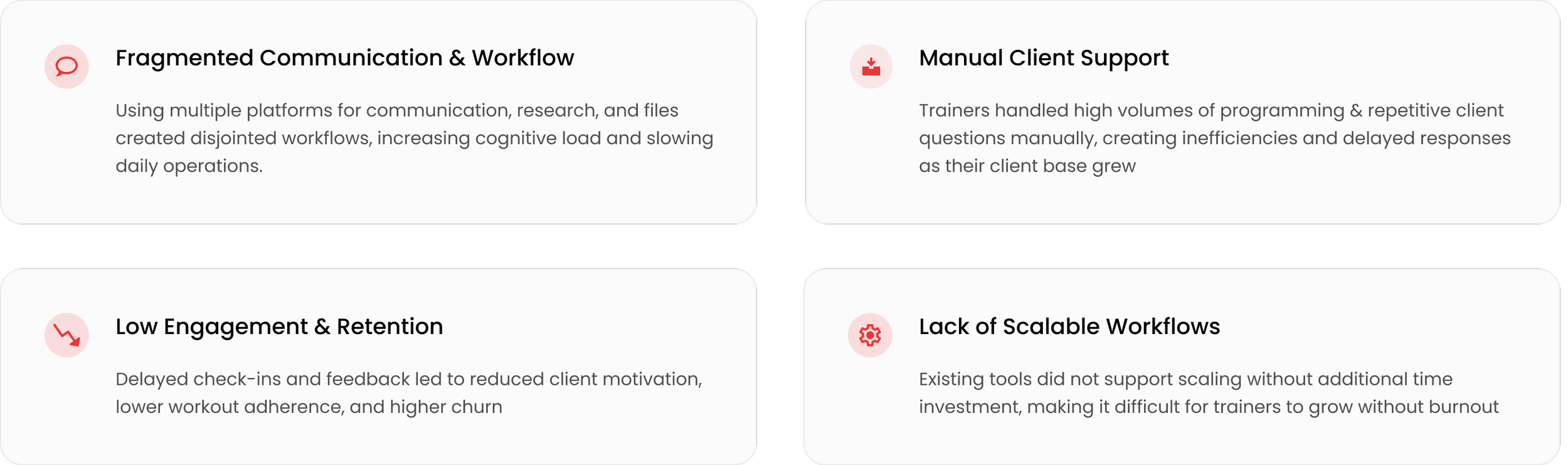
Time-Consuming Admin Tasks Limiting Trainer’s Efficiency
Online coaches spend a significant amount of time managing repetitive administrative work, reducing their ability to focus on coaching, client engagement, and business growth.
PROJECT OBJECTIVES
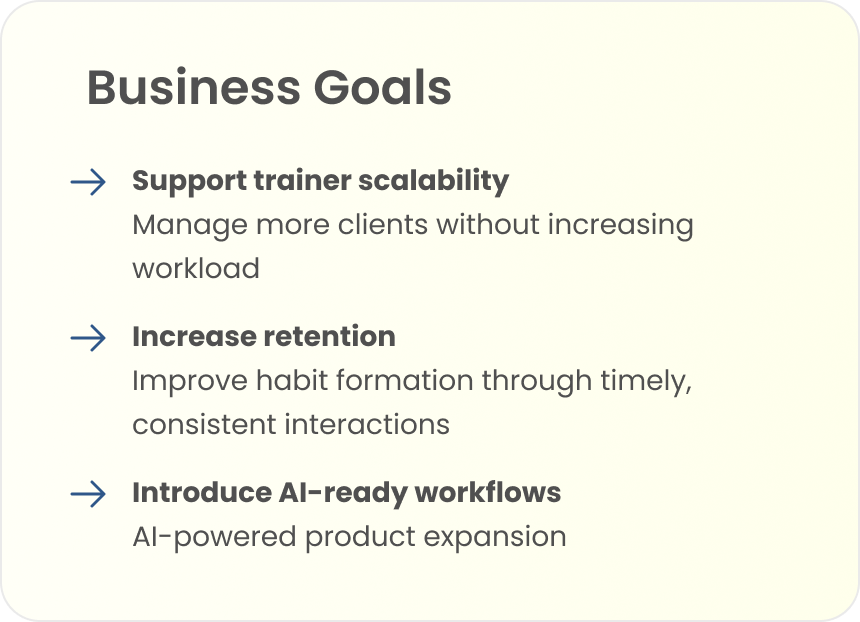
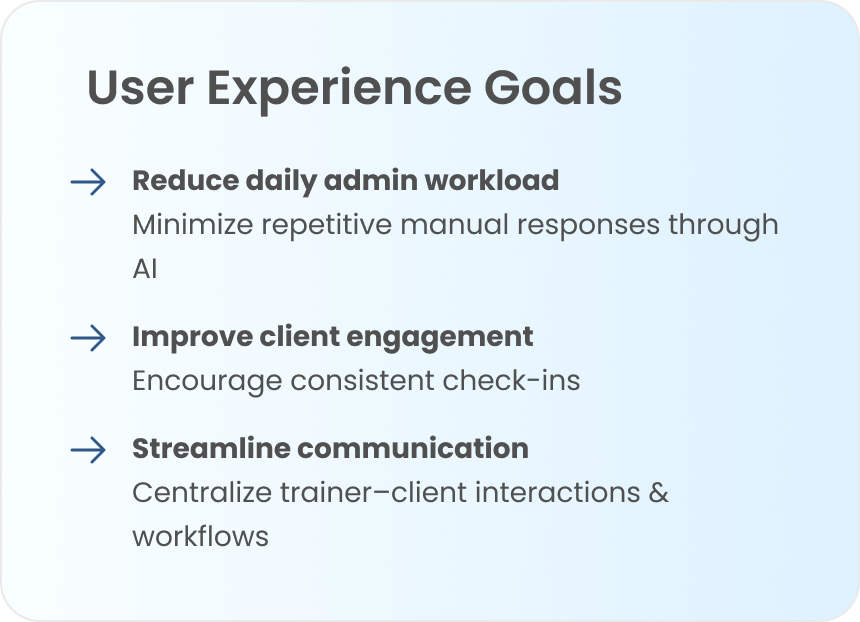
Goals & Success Metrics
Clear UX and product goals were defined to improve efficiency, increase engagement, and support scalable growth for trainers and their clients.
DISCOVERY
User Research & Insights
Conducted mixed-methods research to understand user needs, pain points, and expectations when using a personal training app.

Competitive Analysis
A review of leading online training platforms revealed that most products offer the same core features—workout programming, progress tracking, and basic communication tools. While essential, this has led to a crowded market where platforms feel largely interchangeable

User Personas
A review of leading online training platforms revealed that most products offer the same core features—workout programming, progress tracking, and basic communication tools. While essential, this has led to a crowded market where platforms feel largely interchangeable

User Interviews
Through open-ended conversations, I explored how trainers of all experience levels manage programming, communication, and day-to-day operations, uncovering key pain points, inefficiencies, and opportunities within their existing workflows.

"I often feel frustrated with myself for not providing quicker messages to my clients. I often rely on resources like ChatGPT or YouTube to research answers, which requires me to switch between so many tabs. I want to provide immediate, scientific-driven responses, but my busy schedule makes it difficult”
— Participant #7
Key Findings & Takeaways

Storyboard
To think beyond existing patterns, I stepped away from the screen and sketched out real-world scenarios to imagine how an AI feature could improve the trainer experience.

Jody is on the go and receives a client question that involves research and calculations. The AI feature analyzes the client’s profile and provides Jody with a suggested (and accurate) response to send. The client receives quick & actionable feedback that can be implemented right away, while Jody feels relieved and confident as a trainer
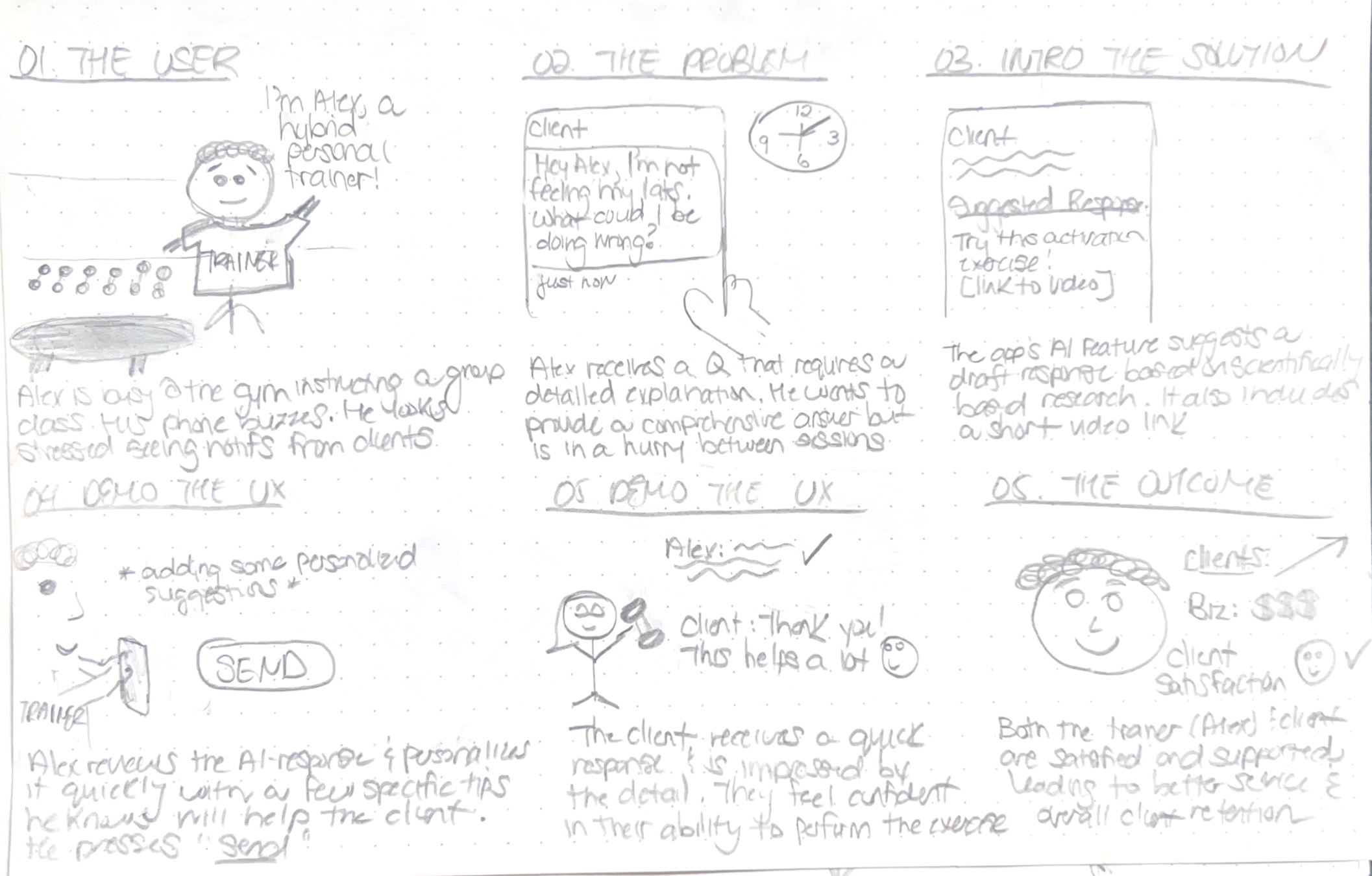
Alex is training a group class at the gym and receives a question that requires a detailed explanation. The AI feature comes to the rescue by suggesting multiple scientific responses. It even attaches a video link for a visual demo. Both the client & trainer feel satisfied and supported leading to client retention, referrals, and better business
Empathy Map
I put myself in the shoes of the trainer to take it one step further to have a full understanding . Having previously worked as an online trainer myself, I was able to draw from firsthand experience with many of these challenges, allowing me to approach the problem with a deeper level of empathy and context.

How might we help trainers manage client queries by providing accurate & personalzied responses to enhance service quality and client experience?
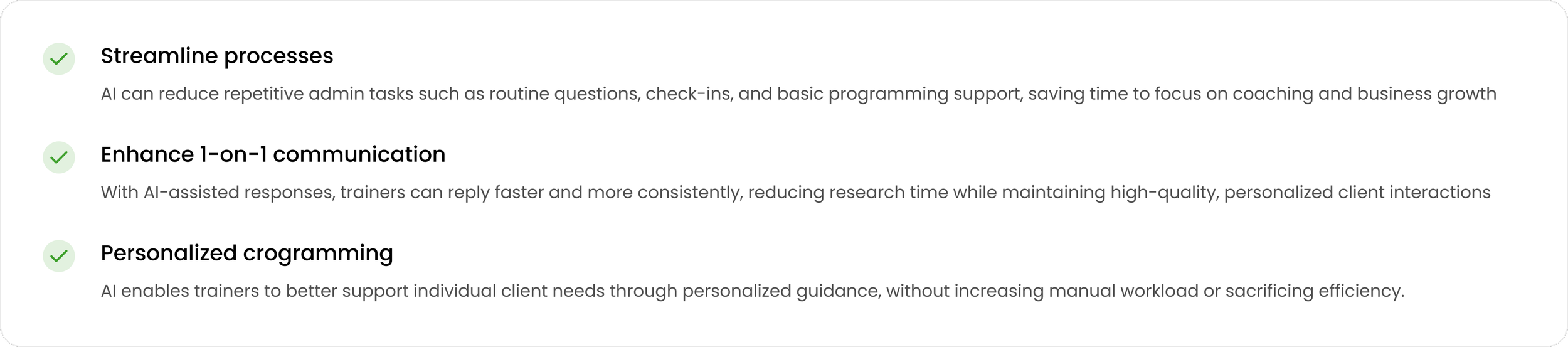
When trainers can work more efficiently, communicate better, and provide personalized services, they’re able to take on more clients without sacrificing quality. This growth benefits the trainers, keeps clients happy and engaged, and ultimately drives success for Trainerize. It’s a cycle where everyone—trainers, clients & the business — thrives together!

PRIORITIZATION
Project Goals
Feature Prioritization Matrix
I knew I needed to add an AI feature but I was unsure where to initially start. My curiosity led to developing a feature set chart where each potential new feature I had in mind was evaluated based on its impact on user experience, alignment with business objectives, and feasibility for implementation to align with both users and business goals

A Phased Approach
After evaluation, I concluded that suggested check-in messages would be quicker and lower in effort to implement, while AI chat integration would provide more value but require more effort. This led to to me proposing a phased approach, to ensure a balance between delivering immediate value and planning for long-term differentiation
This approach ensures that both users and the business benefit quickly while setting the stage for continuous innovation


Design
Crafting two distinct AI solutions—proactive check-ins and intelligent chat responses
User Flows
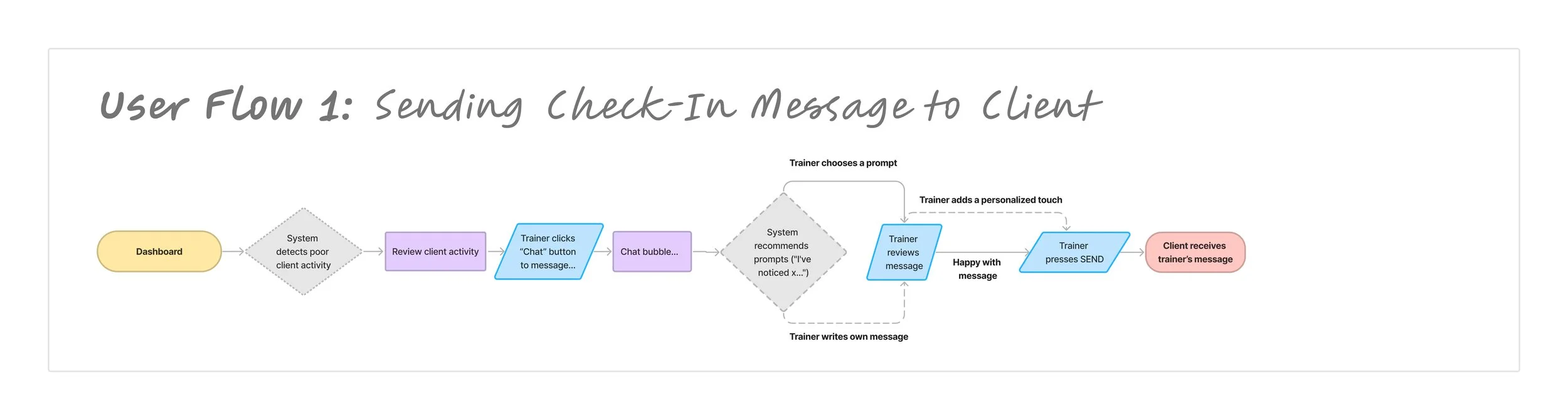
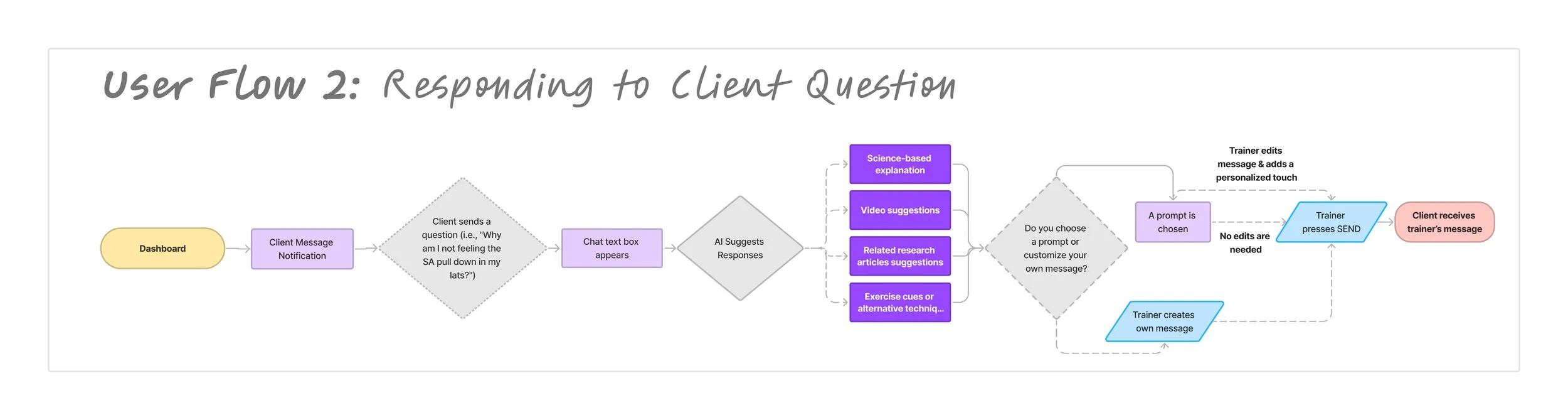
I identified two key scenarios where integrating AI into Trainerize could significantly enhance the trainer’s workflow and improve client engagement
The first flow focuses on proactive engagement through the system detecting poor activity, while the second flow addresses reactive communication where the client reaches out to the trainer with a question and the system provides suggested AI responses


Wireframes
Medium-fidelity screens were created to visualize how AI would fit into Trainerize’s existing UI layout. Using Trainerize’s current design as a baseline, I created intuitive screens for the two key user flows and tested them with 8 users
Phase 1

Phase 2

User Testing Insights


Prototyping High Fidelity Screens📱
Check-in on your clients quicker than ever
Phase 1: AI-Suggested Check-In Prompts Specific to Client Activity
Trainer detects poor activity from client dashboard and follows up with a suggested AI prompt
Provide research-based responses in seconds
Phase 2: AI-Chat Integration to Answer Client Questions
Trainers can respond to client inquiries with research-backed AI suggestions, streamlining the process and saving time

Test
Testing with Trainerize users to validate efficiency gains and measure task completion success
Usability Testing 📊
Task Success Metrics
To validate the success of the designs, I conducted usability tests on 12 online trainers already using the Trainerize app. Both phases were tested to measure their impact on trainer workflows and administrative time
83%
of trainers successfully sent a check-in message in less than 30 seconds
75%
of trainers accurately responded to a question in less than 60s

Next Steps
Proposing AI-driven workout personalization as the next evolution of intelligent coaching
Future Iterations
While usability testing confirmed the success of Phases 1 and 2, I see this as just the beginning of AI integration for Trainerize, with plenty of room for improvement and ongoing innovation
Reflecting on my earlier Feature Prioritization Table, the next logical step is to implement the "should-have" feature: AI-Driven Workout Pesonalization

View other case studies

Fraud-Free Ticket Exchange
A trusted platform for secure ticket buying and selling for events in the EDM scene

Internship Hunt Made Easy
Connecting students and graduates to tailored experiences for professional growth